Let me take you back to another time; a world where the police, the military, the schools, the libraries, the hospitals, the stores, all of this infrastructure we enjoy today — is gone. No government, no television. Most of all, no cars. No cell phones. No oil. A world without guns and swords. This isn’t post apocalyptic fiction. This isn’t dystopia. Once upon a time, this was the real world. Once upon a time, this was the Dark Age.
You might wonder why we should bother going back this far — what it has to do with writing. But it has everything to do with how you pull a sword from the stone.
It’s a familiar story that came out of that age. The knights, King Arthur, Merlin. The boy who would be king, rising up to the challenge of pulling an enchanted sword from an immovable stone, a feat of strength that would cement his divine right to rule.
It’s a strange story, with numerous variations. Monty Python put it best when they said “Listen, strange women lyin’ in ponds distributin’ swords is no basis for a system of government. Supreme executive power derives from a mandate from the masses, not from some farcical aquatic ceremony.” And while they were discussing the Lady of the Lake determining Arthur’s divine right to rule, the point is the same — random allotment of swords don’t exactly prove you’re capable of leading nations.
Or do they.
It was never about a literal sword in the stone. It was about technology and wisdom and warfare. A soldier carrying a gun can take over any town, a show of brute strength is no mean feat. It’s common. It’s unsophisticated, and it only lasts for so long.
It’s the person who knows how to build a gun from scratch — that’s true power, power intrinsic to creation, not destruction. The technology, the alchemy, and the application of skill — these are things that make Queens of mere women, Kings of mere men, and Gods of mere mortals. This — this is what we’re talking about, when we talk about pulling the sword from the stone.
You need stone, to smelt iron. You need iron, to make steel. You need steel, to make swords.
When they say Arthur pulled a sword from the stone, what lies behind the phrase is a more arduous task than we are led to believe: he took raw earth, and made the fire, and spent days baking it in an earth oven so the rock would crack, release the metal and melt it down. Separate the impurities. Take what remained and begin to shape and hammer it out. Heat and cool it endlessly. It took wisdom lost in the fall of Rome. It took knowledge lost with the death of millions in that fall; it took skills lost in the burning of Alexandria. Over time, the story twists. It’s lost in translation. Between the words of ancient texts, we trade in a hard and gritty reality for a convenient fantasy, in which one man’s hard labor that cost him weeks and months if not years of his life, is casually discarded for a fast-food version of the myth. To say the words “pull the sword from the stone” takes five seconds. It gives no respect for the time it took to make a sword from scratch.
By now, the writers reading this will have already figured it out; they think I’m talking about the creative process. And you can draw all the suitable parallels you please. But that’s only half the truth.
We live in a publishing, writing system that doesn’t allow you to pull swords from stones. The writing process alone is but the first part; before our typewriters and keyboards, we’re busy smelting. We aren’t even close to swords yet, not even close to turning our raw materials into a real weapon. Down the line, we’ll shape and hammer with agents, editors, publishers. The sword is what they sell in the storefronts.
Writers. You have no power. Anyone can smelt. It’s not easy; but it can be done. This is the first of many tests that await you, and the vast majority will not pass this.
Not every writer will, like Arthur, smelt and shape and hammer and sell the sword alone. Not every writer will demonstrate the application and holistic understanding of all the technology and discipline involved in the production and process of this singular, and indispensable weapon.
The one who does, will earn their sovereignty over the rest.
You will be more than a writer. You will be an alchemist, a metalsmith, a sword maker. You will know fire and metal, earth and water. You will know the wisdom that has been forgotten. Are you ready, writers?
The stuff of legends await you. You need only pull your sword from the stone.
It is as simple, and insurmountable as that.
For my mother, a metalsmith herself, and a firebrand.
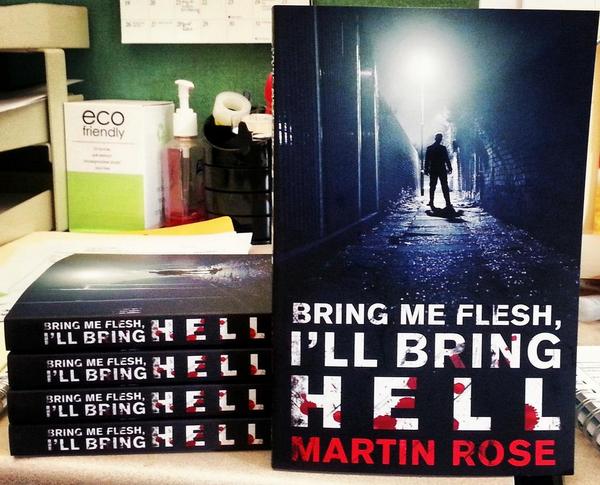
Copies fresh from the press. Pic Credit: Nicole Frail
The release date for Bring Me Flesh, I’ll Bring Hell has been pushed back to October 28th and the book has landed at Skyhorse offices, as you can tell from the above pic. The book will be available at Barnes & Noble and other retailers.
“I know, you will leave me with nothing–neither the laurel nor the rose. Take it all then! There is one possession I take with me from this place. Tonight when I stand before God–and bow low to him, so that my forehead brushes his footstool, the firmament–I will stand again and proudly show Him that one pure possession–which I have never ceased to cherish or to share with all–“
– Edmond Rostand, Cyrano de Bergerac, Act 5
There’s been chatter online about Mrs. Rawson, the daughter of the BTK killer, who came forward to express criticism about a story King wrote, centering around a woman who discovers her husband might be a serial killer. For full context, do follow up at the article, and consider taking the actual time to read it (as opposed to pretending you read it.)
People are attacking Mrs. Rawson for suggesting that King’s work may have influenced her father (and, alternately, attacking her for having the poor taste to be born the daughter of a deeply disturbed man, attacking her for having an opinion, attacking her for having ulterior motives driven by profit, etc.)
In the writing community, none of us want to think too deeply about things we write having the power to affect the world in a negative way, because we prize our freedom to write about what subjects move us. I’ve always supported that freedom, necessary to open and creative cultures, and always will. Mr. Rader has become a public figure as a result of his infamous deeds; his life is therefore open to exploitation. But Mrs. Rawson isn’t asking for legislation to curb writing, and she isn’t telling Mr. King not to write on the subject — she states along the lines that she’d prefer he not have the connection mentioned. From the article: “Stephen King has the right to tell a story, but why bring us into it? Why couldn’t he just find inspiration for another good story, but leave out where it all came from?”
There’s plenty of controversy to pick apart. She calls out King for exploiting these events — and exploit is defined as “to make use of”. She thinks King should contribute profits to good causes. “Exploiting” tragedy is pretty much the foundation of a large majority of our news service and infotainment; if that kind of exploitation stopped tomorrow, our entire media would probably fall apart, but no one’s requesting CNN to donate money to charity. One can make up their own mind on how they feel about those statements, but what surprises me is what many overlooked. While many were eager to speak on how ludicrous it was for Mrs. Rawson to suggest that King’s work is the reason for Mr. Rader’s murders, here’s the point to drive home: Mrs. Rawson never intimated that King is the reason for her father’s murder — only a possible influence on the nature of his crimes.
Of all the books people discussed, not a single person brought up Gerald’s Game in connection to the BTK killer.
Was that a deliberate omission, did not enough people read it, or did it hit a chord too close to home? People felt free to wildly speculate on Mrs. Rawson’s personal motives — but we didn’t dare speculate she might have an intuition the rest of us lack.
We don’t like to imagine a fatherly Mr. Rader, snug on the couch with Kerri by his side, his son on the other, all the affects of a warm and loving family life, as the BTK killer quietly turns a dog-eared, well-loved copy of Gerald’s Game. I owned one myself. I remember the cover well: a handcuff dangling ominously from a headboard.
Consider the troublesome loop of fate: Mr. Rader may have read Gerald’s Game. It’s a speculative guess; but not an improbable one. And down that timeline, imagine Mr. King reading an article on the BTK killer, coming full circle, using the event as an inspirational springboard, as writers are wont to do. An energetic exchange occurs between two men who have never met — an energy neither bad nor good, but neutral. Or perhaps, merely indifferent. Fate, you see, can be elegant, even while it horrifies.
Our own grasp on history is poor at best — it was King himself, not so long ago, who allowed Rage to go out of print, for fear it might inspire school-aged children to commit crimes in the fashion of the book’s troubled main character. I do not get the impression that King was so willing to dismiss connections to his work as having an influence on the world — even while acknowledging that his work is not the reason atrocities occur, as he discusses in his essay, “Guns.” We cannot control what the exterior world does with our work as writers — but that does not make us blind to the effects.
Instead of reasoned argument and rational discourse, civil disagreements, the sharing of opinions and exchange of ideas, what I witnessed in various places was unbridled sadism against Mrs. Rawson, driven by extreme emotion, desire to control and persecute and punish, irrational thought processes, and worst of all, by people who clearly didn’t read the article in the first place. Whether Mrs. Rawson is right or wrong in her assertions is not the debate that has kept me up through the night. How we deal with differing viewpoints is paramount. In a tragic twist of irony, I read comment threads that played out like scenes from the now out-of-print Rage.
And that is behavior that would make any serial killer proud.
When I was a kid, I moved around with frequency. Leapfrogging across a few states, I ended up in the East, and at some point, my parents decided that integrating me into social activities was the order of the day. I think, in their defense, they might not have known what to do with me. I was quiet, I was introspective, and self-possessed; I guarded my privacy with the fierce jealousy reserved for spooks, psychopaths, and mad scientists. As such, I never realized that they probably didn’t know what sort of things I liked or enjoyed, what interests or what hobbies would hold my attention. I didn’t know either.
This led me to sitting in an uncomfortable room with several sensei at a Kenpo Karate school when I was ten. My parents were divorced, and being the new kid for the umpteenth time in an area without friends or connection, this was going to be my new routine.
A few days a week, after a trudging myself through fierce round after round of unrelenting bullying (because after all, I was the new kid), I was dropped off at the Kenpo school and they taught me the basics. I got down the forms. To this day I look back and realize I wasn’t having very much fun. I floated in a fog of deep-set depression. There was no reason to continue. Yet, I did. Somewhere along the way, people decided they didn’t like my ugly mug, so braces were strapped on my teeth in a form of medieval torture for people with the money to afford only the finest in pain.
After a small eternity of training with my sensei, they threw me into a sparring ring. All of us stood there, awkward and unsure of how to start hitting one another. We’d watched the older kids before, but never expected to be there ourselves. You could taste the tension in the air alongside the rank odor of sweat and feet.
I took punches. I took punches and kicks and side kicks. No one’s desire was to maliciously hurt a sparring partner, but accidents happen. I drooled around a set of mouth guards and stared down a series of stretched out, grim faces drooling around their mouth guards, fists up. All of us ugly. I’d get knocked down. I’d get back up. I discovered I was good at sparring, but I was dragging my feet because I didn’t want to knock the shit out of my opponents. But there’s only so long you can hold on to the burning ember within you before it starts burning you up from the inside, so after I’d mastered the art of Human Punching bag, I started moving. Dancing. Weaving. Making moves of my own design to sweep out the feet of my partners, tag them from impossible angles. The mouth guard would end up on the floor and I’d end up on my back, staring at the ceiling. Everything was blood.
“Two!” the sensei shouted.
What the fuck does that mean, I thought.
Turns out, it’s secret code for send in two of the biggest kids with the black belts into the ring to rough me up. Me, dumb fuck kid with the yellow belt gets thrown in with the tigers, with a set of braces and mouth full of blood. It’s like getting punched in the face with a cheese grater on the inside of your lips. You’ll be spitting blood for a week.
I fought. I got knocked down. I got up again. Pain became a new religion. You get on the inside of it and it teaches you things. Like your limitless capacity to bear the indifferent universe and all of life’s vagaries. In only a few short years, I’d drop out of those classes just shy of a black belt myself, and start sending out short stories to fiction markets in 1994, when I was thirteen.
In essence, I traded one sparring ring for another.
This isn’t a meant to be a feel-good anecdote about the triumph of the human spirit, and it isn’t. The greatest opponent, then, as it is now, is always overwhelmingly you. It’s that split second when you’re flat on your back with every muscle burning like a brand, when getting up is insurmountable, and unimaginable. Sometimes, you just don’t get up. Sometimes, you lay blame on the external world for why you can’t get into the ring. You point at the sensei and blame them. They didn’t train you well enough. You point at your opponents. They are too strong, too healthy, too fortunate. They were born with a happy family, many friends. Complications do not dog them. They aren’t new kids, they aren’t wearing braces that pulverize the inside of their mouth every time they take a knock to the face. You blame the cold hard ground, the gravity, the unrelenting despair of your day to day existence. And sometimes, you just give up. Sometimes, the ring isn’t where you’re meant to be. Defeat and retreat is your best option.
For me, writing is a different animal. Forces corral me, without permission. The fatigue of my limbs, the exhaustion of one’s spirit, the appeals of rationality and reason cannot stop this call. We’re conjured up from the killing room floor, seemingly against our will.
All these years later, I get knocked down. I haul up. Spit out the blood, swallow some, start again. There’s figures moving all around. Hushed voices and some numinous, invisible Sensei watching it all from afar, arms crossed, nodding. Go on, then.
“William Butler Yeats combined tarot card readings with astrological predictions (sometimes casting a horary chart for the moment the cards were read) and at the age of sixty-eight, five years before his death, was still calculating his own secondary progressions for the following year. Virginia Woolf noted in her diary: “[Yeats] believes entirely in horoscopes” and “will never do business with anyone” unless he first examines their chart. After his marriage in 1917 to Georgie Hyde-Lees, Yeats also became interested in automatic writing, but it is astrology that most permeates his work.”
This week saw the release of Dark Continent’s The Sea anthology, edited by Nerine Dorman. My story “Canyon” will wash up on shore . . .
Lola and the Seal Lion by Alex Hughes Songs of the Sea by Camille Griep Dead Shark Dawn by Don Webb Sirens by J.C. Piech The Setting Sea by Patrick O’Neill Up She Rises by S.A. Partridge The Something In The Sea by Amy Lee Burgess Dredge by Wayne Goodchild Kajsa’s Curse by Steve Jones Deeper Creatures by Andrea Jones A Cruel, Intemperate Sea by Barry King Canyon by Martin Rose The Wire Bird by Simon DeWar My Name Is Legion by Diane Awerbuck Pins and Needles by Benjamin Knox A Drought of Tears by Rob Porteous Salt by Toby Bennett Choiceless Beach by Anna Reith
Photography by Nerine Dorman, design by Carmen Begley and illustration by Norman Begley.


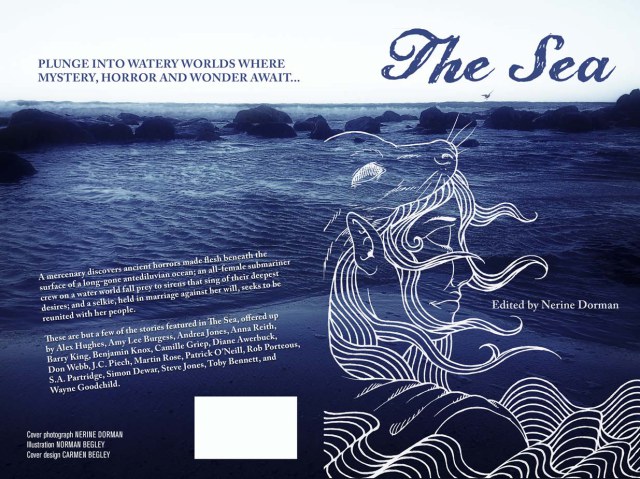 This week saw the release of Dark Continent’s The Sea anthology, edited by Nerine Dorman. My story “Canyon” will wash up on shore . . .
  Martin Rose